
A variant of the game called Triple Draw 2-7, or Lowball, has long been very popular. The winner is the player who manages to get the weakest, or “low,” hand.
How to Play 2-7 Triple Draw (Lowball) Poker?
Triple Draw 2-7 is a duel in which each player is dealt 5 cards. Each player is allowed to exchange any or all of the cards during three hands. The rules also allow for the option to keep the cards they’ve been dealt, rather than participate in the exchange.
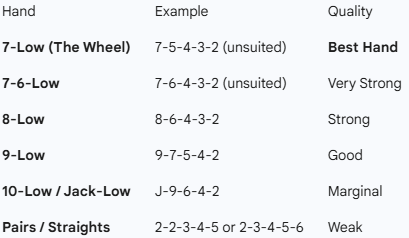
Here are a few important points:
First, you need to understand a couple of fairly simple principles that make learning how to play Triple Draw poker much easier:
Think: A flush and a straight are the weakest hands in Triple Draw 2-7 poker. Aces are always considered higher than other cards here.
Possible Hand Combinations
It’s logical to ask why this game is called Triple Draw 2-7 instead of 2-6, because that’s the range where the five weakest cards are placed. The answer isn’t difficult. A combination of a deuce, a three, a four, a five, and a six creates a straight. In this poker variant, it’s a losing combination (in fact, it’s the opposite).
Consequently, a combination of a deuce, a three, a four, a five, and a seven of different suits is the most powerful combination available. The chances of winning increase if the player manages to collect weak cards. (This may seem like a paradoxical poker game, but when you get down to it, it’s very exciting and thrilling.)
Competition Mechanism
A Lowball poker match begins with a bet. Before each hand, the player to the left of the dealer button posts the small blind.
Typically, the big blind is formed by adding together a pair of small blinds. An ante is often used in this poker variant. This is a bet equal to 10 times the size of the big blind. Once the blinds are available, play can begin.
Card Refresh Procedure
During the first round of betting, players are dealt five cards blind. The player to the left of the big blind (from an early UTG position) then begins betting.
This stage offers the opportunity to make the following moves; read carefully:
folding; accepting a bet; raising; control.
First Replacement. After the betting is complete, the first replacement occurs. The remaining players have the chance to exchange one, several, or all of their cards for new ones.
Second Round. After the first draw, players place their bets again.
Second Replacement. Players replace their cards again if they need to.
Third Round. Poker players place their bets again.
Third Replacement. At this stage, they have the last chance to replace unfavorable cards.
Fourth Round. The final betting round, during which bets can be placed. Following this, the cards are revealed and the hands are compared.
How is the winner determined?
According to the results of the reveal, the player with the best low hand wins the money. If several players simultaneously hold equal hands or values, the money placed on the table (the total pot) is divided equally. After the winners and losers are tallied, a new hand can begin.
Comments are closed