Poker is a table game where each seat has a specific name or “position.” A position isn’t tied to a specific seat at the poker table, but rather moves clockwise with each hand.
All positions can be divided into four groups:
Blinds (Small Blind, Big Blind);
Late Positions (Button, Cutoff);
Middle Positions (Hi-Jack, Lo-Jack);
Early Positions (UTG, UTG+1, UTG+2).
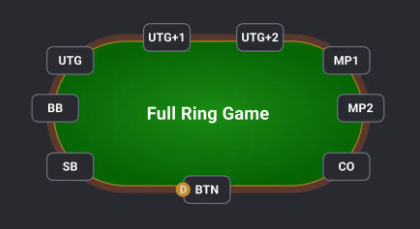
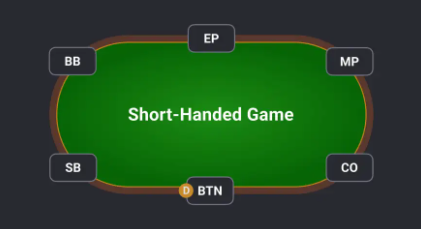
The two most common table types in Texas Hold’em poker are shown in the images:
a full-ring table (9 positions)
a short-handed table (6 positions).
Let’s first understand the concept of position in poker:
Before delving into the details of poker positions, it’s important to understand the meaning of being “in position” in poker. So, if Player A is in position relative to Player B, the following pattern can be assumed:
> Player A is seated to the right of Player B;
> Player A will act after Player B both preflop and postflop.
A player in position gains more information about the hand strengths of other players in front of them based on their actions at the table. Player A, having received information from their opponents, can easily adapt their strategy to suit their needs.
Being in position is the most advantageous situation in poker. Strong players exploit this advantage!
Early Position EP
People seated (UTG, UTG+1, UTG+2) are the first to act preflop. Therefore, these positions can be grouped into Early Position (EP). Early positions are usually difficult to play because they lack information about other players and their actions. Given these circumstances, the opening range for EP should be very narrow.
Middle Position MP
Following early positions are LoJack and HiJack, Middle Position (MP). They interact between early and late positions. The player sitting LJ still needs to be careful with their range, as there are five more players behind them. The player in HJ, having learned about the previous players in EP, can begin adding some tricky or fairly playable suited hands to their opening range to steal the blinds.
Late Position CO
The cutoff comes into effect late preflop. From this “trump” position, the player should begin actively and even aggressively stealing the blinds, as there is only one opponent left in position behind them. If you manage to force the button to fold, you’ll be in position against the blinds for the entire hand.
Button BU, BTN
The button is the best possible position in poker. As the pros say, “the money in poker is made on the button,” as it allows a player to gather information about their opponents and be the last to act postflop. As a result, the button has the widest range of cards to enter the hand with, the widest possible range of possible lines of play, and the most concealed and least vulnerable position.
In home games, the player in the button position is also responsible for dealing the cards in the current hand.
Blinds: Small Blind SB, Big Blind BB
The small blind sits first to the left of the dealer button. Having received some fairly extensive information about their opponents preflop, they always initiate action postflop, which is always much more difficult than being in position.
The big blind is the worst and one of the most difficult positions at the poker table. Due to the mandatory postion of a full blind before seeing cards, the BB must play a wide range of hands out of position on every street.
Another advantage of playing in the BB is that you get improved pot odds for entering preflop. Therefore, hands that are unplayable in other positions, even on the button, are often played from the big blind.
A good understanding of positions in poker, when used to advantage, increases your EV at the table!
Comments are closed